
Are struts and strut mounts the same?
Confusion between suspension components is a leading cause of incorrect parts ordering and incomplete repairs in the aftermarket industry. While they function as a cohesive unit to control vehicle dynamics, assuming struts and strut mounts are identical leads to unresolved noise complaints and safety hazards.
No, struts and strut mounts are not the same; the strut is the hydraulic damper that controls spring oscillation, while the strut mount is the structural anchor point that connects the strut to the vehicle chassis. The mount also contains a bearing to facilitate steering, making it a distinct mechanical component with its own failure modes.

Understanding the engineering differences between these two parts is essential for distributors and technicians who want to reduce warranty claims and improve customer satisfaction.
Are struts and strut mounts the same?
Although they are assembled together, their roles are fundamentally different: one manages energy, and the other manages geometry and attachment.
The strut is a hydraulic cylinder designed to absorb kinetic energy from the road, whereas the strut mount acts as the "pivot point" and insulator between the suspension and the car body. Think of the strut as the leg muscle and the mount as the hip joint; one absorbs the impact, while the other allows for movement and articulation.

Dive Deeper:
To truly appreciate the distinction, we must look at the CAE Analysis (Computer-Aided Engineering) of a MacPherson strut system.
The Strut (Shock Absorber):
The strut itself is a major structural part of the suspension system, but its primary internal function is hydraulic. It contains a piston, valves, and hydraulic fluid. Its job is to provide damping—specifically, to convert the kinetic energy of the spring’s movement into heat energy, stopping the car from bouncing uncontrollably after a bump. It handles vertical forces primarily.
The Strut Mount:
The strut mount sits at the top of this assembly and serves three distinct, critical functions that the strut cannot perform:
- Structural Attachment: It physically bolts the suspension to the vehicle’s unibody (strut tower). Without it, the strut would punch through the hood.
- NVH Isolation: It contains a high-density rubber cushion. This rubber isolates the chassis from high-frequency road vibrations and tire noise. Even if a strut is working perfectly, without the mount’s isolation, the ride would feel incredibly harsh.
- Steering Pivot (The Bearing): This is the most critical differentiator. In a front suspension, the entire strut assembly must rotate when the driver turns the steering wheel. The strut mount houses a rolling bearing that bears the entire weight of the vehicle’s front corner while allowing smooth rotation.
The B2B Implication:
A common error in repair shops is "pad slapping" the suspension—replacing the strut cartridge (because it is leaking) but reusing the old mount to save money. This is a false economy. The old mount has endured the same Fatigue Life cycles as the strut. Reusing an old mount on a new strut creates a "weak link" in the chain. The new strut will dampen the big bumps, but the worn rubber in the old mount will transmit vibration, and the gritty bearing will cause steering noise, leading to a customer comeback within weeks.
Can a strut mount make noise?
Noise is the number one symptom of strut mount failure, specifically indicating issues with the integrated bearing or structural integrity.
Yes, a bad strut mount often produces a hollow "clunking" sound when driving over bumps or a "grinding" and "popping" noise when turning the steering wheel. These sounds are distinct from strut noises and are caused by friction in the seized bearing or metal-on-metal contact due to rubber collapse.

Dive Deeper:
The noise generated by a failing strut mount is almost always a result of environmental intrusion compromising the internal components. This is where the quality of the manufacturing process becomes the deciding factor in the part’s longevity.
I recently watched a video that systematically breaks down the symptoms of a bad strut mount. The analysis specifically points out that environmental stressors—like rain water, ice, and road salt—are the primary enemies of these components. The video explains that once these elements penetrate the mount, they hasten the failure, leading to that characteristic clunking noise and excessive vibration. This aligns perfectly with the reality that strut mounts are constantly exposed to the harshest elements in the wheel well.
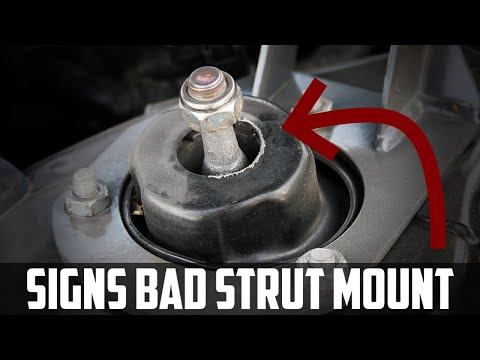
The Engineering Challenge: Water Intrusion
As highlighted by the failure symptoms, the strut mount1 sits high in the wheel well, an area constantly bombarded by road spray. In inferior aftermarket parts2, the bearing is often shielded only by a basic dust cover. Once water penetrates this weak barrier, it emulsifies the grease and corrodes the hardened steel surfaces.
GSW’s Solution: Special Sealing Design
At GSW, we understand that noise is a direct result of seal failure. Therefore, we utilize a Special Sealing Design for our strut mount bearings. Unlike standard single-lip seals, our bearings feature a multi-barrier design that provides superior ingress protection.
- Grease Retention: The seal is engineered to keep our high-grade, temperature-resistant grease inside the race, ensuring consistent lubrication coefficient even in freezing conditions.
- Contaminant Exclusion: The geometry of the seal creates a labyrinth path that prevents water and road salt from reaching the rolling elements.
By prioritizing this sealing technology, we significantly extend the Fatigue Life of the component. A noise-free strut mount is not just about the rubber; it is about the integrity of the bearing seal. For your customers, this means the difference between a repair that lasts 50,000 miles and one that starts squeaking after the first heavy rain.
Can a bad strut mount cause vibration?
While noise is annoying, vibration indicates that the mount’s isolation capabilities have completely degraded, affecting ride quality and steering precision.
Yes, a compromised strut mount can transmit excessive road vibration through the steering column and into the driver’s hands. This occurs when the rubber element loses its elasticity or fractures, eliminating the buffer zone between the rigid suspension and the cabin.

Dive Deeper:
To understand vibration, we must discuss the material science of the mount. The rubber insert in a strut mount is not just a spacer; it is a tuned damper. It is engineered with a specific Shore Hardness A to filter out specific frequencies—typically the high-frequency "buzz" from tire-to-road contact.
The Physics of Failure:
Over time, rubber undergoes a process called hardening or oxidative aging. Heat cycles from the engine bay and exposure to ozone cause the rubber to cross-link excessively, becoming brittle.
- Loss of Hysteresis: Fresh rubber dissipates energy (hysteresis). Old, hard rubber conducts energy. When the mount hardens, it stops absorbing the micro-vibrations from the road.
- Structural Separation: In severe cases, the rubber separates from the metal sleeve (debonding). When this happens, there is no isolation left. The metal strut shaft bangs directly against the metal mount housing.
Symptoms of Vibration:
- Steering Shimmy: Unlike a wheel balance issue which usually happens at specific speeds (e.g., 60-70 mph), strut mount vibration can be felt at all speeds and changes with road surface texture.
- Harshness: The driver will feel every crack and expansion joint in the road as a sharp jolt rather than a muted thud.
Why GSW Matters:
We control our rubber mixing in-house to ensure the Shore Hardness A remains stable over years of use. We test our mounts using dynamic fatigue machines to simulate millions of cycles, ensuring that the NVH (Noise, Vibration, and Harshness) characteristics remain within OE specifications throughout the lifespan of the part. If a mount is too soft, steering feels vague; if it is too hard (or cheap plastic), it causes vibration. GSW hits the "Goldilocks" zone of precise engineering.
When to replace them?
Timing the replacement of strut mounts is crucial for maximizing labor efficiency and ensuring vehicle safety.
You should replace strut mounts every time you replace the struts or coil springs, typically between 50,000 to 80,000 miles. Reusing old mounts on new struts is unsafe and uneconomical, as the labor required to access them later duplicates the initial repair cost.

Dive Deeper:
The industry standard recommendation is "One Strut, One Mount." This isn’t just a sales tactic; it is based on the mechanical reality of the suspension system.
The Economic Argument (Labor Overlap):
To change a strut, a technician must remove the wheel, disconnect the sway bar links, unbolt the strut from the knuckle, and remove the top mount bolts. To change just the mount later, they have to do 100% of that work again.
- Scenario A: Customer replaces struts only ($). 3 months later, the old mount bearing fails. Customer pays for labor again ($$). Total cost: $$$ and a loss of trust.
- Scenario B: Customer replaces struts and mounts together ($+part). Total cost: $ and a restored car.
Explaining this "labor overlap" is the most effective way for service advisors to sell the complete job.
The Safety Argument (Steering Returnability):
A worn strut mount bearing increases friction in the steering system. This affects the vehicle’s "returnability"—the ability of the steering wheel to center itself after a turn. If a driver installs high-performance struts but keeps old, sticky mounts, the steering feel will be unpredictable.
CAE Analysis of Stress:
New struts restore the original damping forces. This means the suspension will be firmer and transfer force more effectively. An old, weakened mount that was "surviving" on soft, worn-out struts will often fail immediately when subjected to the higher forces of a new strut. The rubber cannot handle the restored performance parameters.
For B2B inventory planning, we recommend stocking "Strut Kits" or ensuring that for every strut part number sold, the corresponding mount part number is suggested. This practice drastically reduces the "return rate" of struts that are falsely claimed as defective when the noise was actually coming from the old mount.
Conclusion
Struts and strut mounts are distinct components: one dampens motion, the other anchors the system and enables steering. A bad mount causes noise via rusted bearings and vibration via hardened rubber. GSW’s Special Sealing Design directly addresses the root cause of bearing failure, offering a superior lifespan. Would you like me to provide a comparative lifespan analysis of standard seals versus GSW’s multi-lip design for your sales team?
About the Author
Root is a Content & Operations Specialist at GSWAUTOPARTS with 5 years of industry experience. Leveraging his close proximity to our manufacturing floor, Root specializes in documenting product details and production processes. He focuses on translating technical insights about rubber and chassis parts into clear, helpful information for our customers.


