
Can you reuse u bolts?The Definitive Guide for Suspension Safety
For fleet managers and mechanics, the temptation to reuse hardware during a leaf spring replacement is understandable—it saves time and budget. However, U-bolts are not standard fasteners; they are the critical safety link in your suspension system. Reusing them isn’t just a shortcut; it is a liability.
The short answer is: No, you should never reuse U-bolts. Once torqued to their final specification, U-bolts undergo Plastic Deformation (permanent stretching). Attempting to reuse them results in false torque readings, loss of clamping force, and potential suspension failure. Always replace U-bolts when installing new leaf springs.

Understanding the engineering behind why these bolts are "one-time-use" is critical for maintaining vehicle safety and preventing costly comebacks.
What Are U Bolts and Their Function in Leaf Spring Suspensions?
U-bolts are designed to secure the leaf spring pack to the axle, effectively welding the two components into a single unit through friction. They are not merely holders; they are active clamping devices.
U-bolts provide the critical Clamping Force required to prevent the leaf spring from shifting on the axle pad. Without this immense pressure, the center bolt would shear instantly under lateral loads.

Dive Deeper: The Physics of Clamping Force and NVH
To understand why GSW emphasizes the quality of U-bolts so heavily, we must look at the physics of the suspension system. Many mechanics mistakenly believe that the center pin (or center bolt) holds the axle to the springs. This is incorrect. The center pin is merely a locator used to align the leaves during assembly. It has low Shear Strength and cannot withstand the forces generated during braking, acceleration, or cornering.
The U-bolts are responsible for generating Clamping Force. When tightened to specification, they compress the leaf spring pack against the axle seat. This compression creates a friction bond so strong that the spring and axle move as one solid object. If this clamping force is insufficient—due to low-quality steel or improper torque—the bond breaks.
Once that friction bond is broken, the leaf springs begin to slide back and forth on the axle pad. This movement introduces severe NVH (Noise, Vibration, and Harshness) issues, often manifesting as a clunking sound during stops or starts. More dangerously, this movement places shear stress on the center pin, snapping it. Once the center pin snaps, the axle can shift completely, leading to catastrophic loss of vehicle control.
At GSW, our manufacturing process prioritizes Tensile Strength to ensure this clamping force is maintained throughout the vehicle’s service life. We utilize specific steel grades and heat treatment processes that prevent the bolts from "relaxing" or stretching further under load after the initial installation. A high-quality U-bolt acts as a permanent lock, whereas inferior steel will elongate over time, loosening the connection and degrading the vehicle’s handling.
Can you reuse u bolts on leaf springs?
Absolutely not. U-bolts are classified as "Torque-to-Yield" (TTY) hardware. Upon installation, the threads stretch permanently to lock the nut in place.

Dive Deeper: Material Science, Plastic Deformation, and The Evidence
The engineering principle forbidding the reuse of U-bolts is based on the difference between Elastic Deformation and Plastic Deformation.
I recently watched a video featuring Mike Eaton from Eaton Detroit Spring that perfectly illustrates this concept. In the video, they explain that U-bolts are manufactured with "rolled threads" rather than cut threads. Rolled threads are stronger because the grain of the steel flows with the thread shape. However, to achieve the necessary clamping force, the nut must be tightened until the bolt stretches.
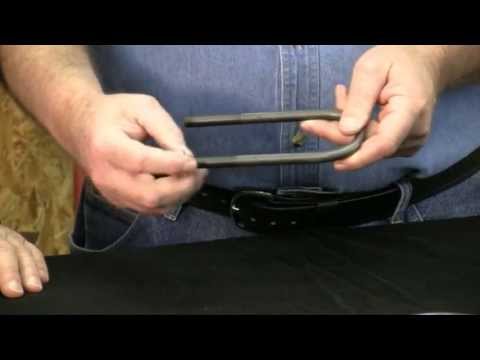
When a bolt is stretched within its Elastic Limit, it will return to its original shape when loosened—like a rubber band. However, U-bolts are often tightened past this limit into the zone of Plastic Deformation. Think of this like pulling a piece of taffy or chewing gum; once it stretches, it never goes back. The threads distort, the rod diameter thins slightly, and the metal hardens.
If you attempt to reuse this bolt, two things happen:
- False Torque Readings: Because the threads are distorted, friction between the nut and the bolt increases. Your torque wrench might click at 100 ft-lbs, but because of the friction, only 50 ft-lbs of that energy is actually creating clamping force. The rest is wasted as heat.
- Fatigue Life Failure: The metal has already been stressed near its Yield Point. Re-tensioning it creates "stress risers" (micro-cracks) in the thread valleys. This drastically reduces the Fatigue Life of the steel. The bolt might hold initially, but it will likely snap under the cyclic loading of daily driving.
For a customer, saving $30 on bolts is not worth the risk of the axle detaching from the vehicle on the highway. This is why GSW mandates new hardware with every leaf spring shipment.
How to Properly Install U Bolts for Leaf Springs?
Proper installation involves cleaning the mounting surfaces, using a cross-pattern tightening sequence, and strictly adhering to the manufacturer’s torque specifications.
Crucially, you must re-torque the U-bolts after 100 to 500 miles of driving. This accounts for the "settling" of the new spring pack and prevents loosening.

Dive Deeper: The Mechanic’s Protocol for Longevity
Even the highest-grade GSW U-bolt can fail if installed incorrectly. We recommend a strict protocol to ensure maximum Fatigue Life and safety.
1. Surface Preparation: Before installing new U-bolts, the axle seat and the top plate must be free of rust, debris, and old paint. Any unevenness here acts as a pivot point, introducing bending stresses that U-bolts are not designed to handle. U-bolts are designed for pure tension, not bending.
2. The Tightening Sequence: Never fully tighten one leg of the U-bolt before the others. This cocks the U-bolt sideways and creates uneven stress. The correct method is to bring the nuts up snug evenly, then use a "X" or cross-pattern to step up the torque.
- Step 1: Snug all nuts.
- Step 2: Torque to 50% of spec in a cross pattern.
- Step 3: Torque to 100% of spec in a cross pattern.
3. The Impact Gun Danger: While impact guns are efficient, they are the enemy of U-bolts during the final stage. The high-speed hammering can overheat the threads (galling) or overshoot the yield point of the steel. Always use a calibrated hand torque wrench for the final tightening.
4. The Critical Retorque: This is the step most often skipped by DIYers and hurried shops. Freshly installed leaf springs will "settle" as the layers compress and the paint wears down slightly between the leaves. This settling reduces the clamping distance, causing the U-bolts to lose tension. If they are not re-torqued after a short break-in period (typically 100-500 miles), the clamping force will drop below the critical threshold, leading to the NVH and center pin failure scenarios mentioned earlier.
When to Use Custom U Bolts?
Stock U-bolts are designed for stock suspensions. You need custom solutions when adding lift kits, helper springs, or swapping axles, as the required length and bend radius change.
Custom U-bolts ensure the correct rod diameter and leg length to engage the threads fully without bottoming out or leaving insufficient thread engagement.

Dive Deeper: Sales Enablement for Modified Rigs
In the world of heavy-duty trucking and off-road modification, "one size fits all" rarely applies. This is where GSW’s ability to provide specific standards becomes a major asset for your inventory.
The "Stack Height" Challenge:
When a customer installs an "Add-a-Leaf" kit or replaces a 3-leaf pack with a heavy-duty 5-leaf pack1, the physical height of the spring stack increases. Reusing old bolts here is physically impossible, but even buying standard OEM replacements might fail if they are too short. The nut must fully engage the threads with at least two threads showing past the nut to ensure security. Conversely, if a bolt is too long, a deep socket might bottom out on the axle before the nut is tight.
Diameter and Tensile Strength:
When vehicles are modified for heavier loads, the lateral forces on the suspension increase. A standard 7/16" rod might not provide enough Tensile Strength or Clamping Force for a lifted truck running oversized tires. Upgrading to a 1/2" or 9/16" rod (provided the u-bolt plate can accommodate it) offers a significant safety upgrade.
Shape Matters:
The shape of the U-bolt (Round, Semi-Round, or Square) must match the axle or leaf spring plate perfectly.
- Round Bend: Typically for wrapping around a round axle tube.
- Square Bend: Used for flat mounting surfaces or square truck axles.
- Semi-Round: Often found on specific Toyota or heavy-duty applications.
Using the wrong shape creates point-loads—tiny areas of extreme pressure—that act as Stress Risers, leading to premature snapping of the bolt.
At GSW, we don’t just sell part numbers; we sell the correct metallurgy and geometry. Whether your customer needs a standard replacement or a custom length for a lifted application, ensuring they have the right "High Tensile" hardware is the final step in a successful suspension job.
Conclusion
U-bolts are the unsung heroes of the suspension system2, holding the entire weight of the vehicle’s connection to the road. They are single-use items designed to stretch and lock. Reusing them compromises the physics of the suspension, inviting noise, breakage, and accidents. For every spring job, ensure safety and performance by installing new, high-quality GSW U-bolts.
About the Author
Root is a Content & Operations Specialist at GSWAUTOPARTS with 5 years of industry experience. Leveraging his close proximity to our manufacturing floor, Root specializes in documenting product details and production processes. He focuses on translating technical insights about rubber and chassis parts into clear, helpful information for our customers.


