
How long do sway bar bushings last?
Chassis clunking ruining your ride? Sway bar bushings take a severe beating under constant chassis torsion. Ignoring their degradation inevitably leads to sloppy handling and poor NVH control.
On average, high-quality sway bar bushings last between 50,000 to 100,000 miles, depending on driving conditions and material quality. However, aggressive cornering, extreme weather exposure, and poor road surfaces can significantly reduce their operational lifespan, necessitating an earlier replacement.

Understanding the exact lifespan and failure signs of these critical components can save you from costly suspension repairs down the line. Let’s break down exactly what affects their longevity and how to identify when they are completely worn out.
What is a sway bar bushings and what does it do?
These seemingly simple rubber components are the unsung heroes of your suspension system, isolating the chassis from the sway bar while allowing controlled rotational movement.
A sway bar bushing mounts the heavy metal sway bar to the vehicle’s frame. It absorbs road vibrations and prevents metal-to-metal contact, ensuring the sway bar can effectively reduce body roll during cornering.

From a strict physics and materials engineering perspective, the sway bar bushing is subjected to immense punishment. When a vehicle enters a sharp turn, weight transfer exerts extreme torsional stress on the suspension framework.
The sway bar must twist aggressively to counteract this body roll, and the bushings act as the critical pivot and clamping points. From an engineering standpoint, these parts endure relentless cyclical loading over millions of micro-movements. This is where the material science behind the rubber becomes absolutely crucial. At GSW Autoparts, our engineering team focuses heavily on optimal Shore Hardness A calibration.
If the rubber is too soft, the sway bar flexes excessively, resulting in a spongy ride and highly inaccurate handling. If it is too hard, it transfers harsh vibrations directly into the cabin, severely degrading the vehicle’s overall NVH (Noise, Vibration, and Harshness) profile. We achieve the perfect balance through an advanced vulcanization process.
During this process, the rubber compound is cured under immense pressure and heat to align the polymer chains, yielding superior tensile strength and ensuring the bushing does not tear under extreme cornering loads. Before a bushing ever sees the road, it undergoes rigorous CAE Analysis (Computer-Aided Engineering) to simulate thousands of miles of dynamic loading, allowing us to predict the fatigue life of the rubber compound under extreme chassis torsion.
I recently watched a video by a suspension manufacturer detailing exactly how a sway bar works, and it perfectly illustrated how much the bar twists within its mounting brackets during evasive maneuvers. It is fascinating to see the raw mechanical forces at play and how much stress the rubber absorbs.

When explaining this to a car owner, do not just say "it’s a piece of rubber." Tell them it is the critical, heavy-duty cushion that stops massive steel suspension parts from grinding against their car’s frame. High-quality vulcanized rubber means they get a smooth, quiet ride that lasts years longer than cheap, poorly formulated aftermarket alternatives.
Symptoms of a Bad Sway Bar Bushings
Diagnosing a failing bushing early can prevent severe cascading damage to your steering geometry, saving the suspension from unnecessary and excessive lateral stress.
The most common symptoms include a distinct clunking or rattling noise over bumps, sluggish handling, and excessive body roll. A squeaking sound originating from the front or rear suspension is also a prime indicator of rubber degradation.

NVH control is paramount in modern vehicle design, and the sway bar bushing is the primary isolator for lateral chassis harmonics. When this rubber degrades, its internal bore widens due to friction, or the material becomes brittle and cracks from environmental exposure.
This degradation destroys the tight engineering tolerance required to hold the sway bar firmly against the vehicle’s subframe. From a veteran mechanic’s perspective, this is a textbook mechanical failure.
The distinct "clunk" you hear is literally the heavy steel sway bar slamming directly into the metal mounting bracket because the vulcanized rubber cushion has completely worn away. This violent impact sends shockwaves directly into the cabin, causing immediate driver discomfort.
Furthermore, visual inspection of a failed unit often reveals advanced dry rot, deep structural cracking, or a bushing that has become completely deformed from its original D-shape.
Our GSW replacement parts utilize heavily fortified, high tensile strength rubber specifically formulated to resist this type of mechanical tear, environmental breakdown, and structural collapse, ensuring a significantly longer fatigue life under heavy use.
I recently watched a video titled "What A Bad Sway Bar Bushing Sounds Like" by klowny1969, and it brilliantly captured the exact moment a degraded bushing fails. You can clearly hear the loud, hollow "clunking" sound every time the vehicle hits a minor bump, perfectly demonstrating the complete loss of NVH control.
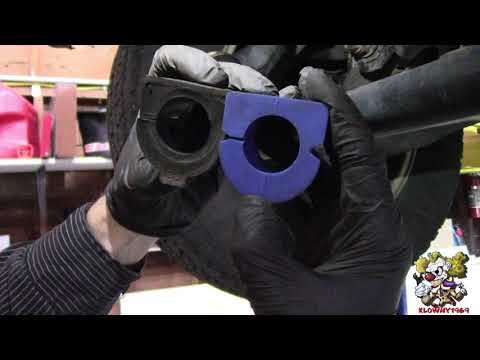
To easily explain this to a vehicle owner, ask them if their car sounds like there is a heavy bowling ball loose in the trunk when they drive over a speed bump or pull into a driveway. Explain that a worn bushing acts like a worn-out shoe insole; without that cushioning, the metal suspension parts are taking direct, painful hits. Upgrading to parts with superior fatigue life ensures that annoying clunk never returns.
Can you drive with bad sway bar bushings?
While your vehicle won’t suddenly collapse, driving with compromised bushings introduces significant handling risks and actively accelerates the destructive wear of other suspension components.
You can technically drive with bad sway bar bushings, but it is highly discouraged by automotive professionals. It seriously compromises vehicle stability, increases dangerous body roll, and negatively impacts emergency maneuverability, making the car less safe.

Ignoring a worn sway bar bushing is playing a very dangerous game with vehicle dynamics and overall safety.
The primary function of the sway bar system is to keep the tires planted flat on the road during a turn by transferring force from the outboard suspension to the inboard suspension. When the bushings fail and develop excessive play, there is a pronounced delay in this force transfer. This latency results in extreme body roll, unpredictable weight shifting, and a profound loss of tire traction.
During an emergency evasion maneuver, such as swerving rapidly to avoid a sudden obstacle on the highway, this lack of chassis stability can easily lead to a total loss of steering control or, in the worst-case scenario involving top-heavy SUVs, a rollover accident.
Beyond the immediate safety risks, driving on bad bushings causes severe mechanical cascading failure. The excessive, uncontrolled movement of the heavy sway bar puts unnatural stress on the sway bar end links, often snapping their ball joints prematurely. Through rigorous CAE Analysis conducted by our R&D teams, we have observed that failing to isolate these intense vibrations drastically reduces the fatigue life of surrounding suspension parts, particularly delicate control arm bushings and steering tie rod ends.
I recently watched a diagnostic video demonstrating what happens when you drive with a failing sway bar system, and it highlighted how excessive play in the mounting brackets forces the sway bar links to absorb lateral shocks they were never engineered to handle. This inevitably leads to rapid, catastrophic failure of the entire linkage system.

Tell the car owner that delaying this relatively inexpensive repair is exactly like ignoring a small leak in a boat. It might not sink the vehicle today, but it is actively causing invisible, highly destructive damage to much more expensive suspension components. Investing in premium replacement bushings now protects both their physical safety and their wallet in the long run.
Do you grease sway bar bushings?
The lubrication of suspension bushings is a heavily debated topic in garages, but applying the wrong chemical can instantly destroy the structural integrity of the rubber.
Standard rubber sway bar bushings should never be greased with petroleum-based products, as it rapidly degrades the material. However, aftermarket polyurethane bushings often require a specific, heavy-duty silicone-based grease to prevent severe squeaking.

The relationship between applied grease and bushing materials is strictly governed by chemistry, and making a mistake here is catastrophic. The vast majority of OEM and premium aftermarket sway bar bushings, including the high-durability components manufactured by GSW Autoparts, are made from high-grade natural or synthetic vulcanized rubber. Introducing a standard petroleum-based grease (such as standard chassis lube, engine oil, or WD-40) to this vulcanized rubber is a fatal error.
The petroleum acts as a solvent, causing a severe chemical reaction that forces the rubber to swell, soften, and eventually disintegrate into a sticky paste. This chemical breakdown rapidly destroys the precisely engineered Shore Hardness A rating of the component. Once the Shore Hardness A is compromised, the bushing loses all its tensile strength and becomes a gummy mess that cannot hold the sway bar in place, leading to immediate mechanical failure and severe NVH issues.
If a standard rubber bushing1 is squeaking, it usually indicates that the internal bore is worn smooth or the rubber has naturally oxidized over years of use; replacement is the only true mechanical fix. Conversely, aftermarket polyurethane bushings2 are notoriously squeaky due to their high friction coefficient against steel, requiring sticky, waterproof Teflon or silicone-based grease to maintain proper, quiet operation.
When advising a customer, use the analogy of washing a delicate silk shirt with harsh industrial bleach. Explain that using the wrong grease will literally melt their suspension parts from the inside out. If they have standard rubber bushings, tell them they are meticulously engineered to be maintenance-free and run dry. If it squeaks, it’s time to replace it with a fresh, factory-spec GSW bushing.
Conclusion
Sway bar bushings are absolutely critical for maintaining tight handling, safety, and excellent NVH control. If you are experiencing suspension clunks, it is time for an upgrade. Contact GSW Autoparts today to source premium, rigorously tested replacement components designed for maximum fatigue life and superior road performance.
About the Author
Root is a Content & Operations Specialist at GSWAUTOPARTS with 5 years of industry experience. Leveraging his close proximity to our manufacturing floor, Root specializes in documenting product details and production processes. He focuses on translating technical insights about rubber and chassis parts into clear, helpful information for our customers.


