
How to install lower control arm bushings?
Is your vehicle suffering from erratic steering, uneven tire wear, or clunking noises over bumps? These symptoms often point to failed lower control arm bushings, a critical component that bridges the gap between your chassis and suspension.
To install lower control arm bushings, you must secure the vehicle, remove the control arm, and use a hydraulic press or specialized bushing tool to extract the old unit. Ensuring the new bushing is seated with correct orientation is vital for maintaining the vehicle’s original NVH profile and suspension geometry.

Transitioning from a noisy, unstable ride to factory-smooth performance requires more than just brute force; it demands an understanding of material science and precision engineering. At GSW Autoparts, we specialize in high-precision rubber-to-metal bonding that makes the installation process seamless and the results long-lasting.
How to replace a lower control arm bushing?
Replacing a lower control arm bushing is a precision task that requires removing the arm, pressing out the degraded rubber, and carefully seating the new GSW high-performance bushing.
Successful replacement hinges on using a dedicated press tool to apply even force. You must align the bushing marks with the control arm’s axis to prevent premature failure, ensuring the rubber is not pre-twisted during the final torquing process.

Dive Deeper Section:
The replacement of a lower control arm bushing is a sophisticated mechanical operation that sits at the intersection of heavy-duty labor and delicate engineering precision. From a veteran engineer’s perspective, the most critical phase isn’t just "getting the old one out," but ensuring the integrity of the housing remains intact during the extraction. When a technician uses a hydraulic press, they are managing several tons of force. If the receiving cup is not perfectly aligned, the bore of the control arm can become elongated or scored, leading to a loose fit that no new bushing can fix.
At GSW, we utilize CAE Analysis (Computer-Aided Engineering) to simulate these installation stresses. We understand that in the field, technicians face varying levels of equipment quality. Therefore, our bushings are designed with a lead-in chamfer on the outer metal sleeve. This slight taper significantly reduces the initial force required to "seat" the bushing, preventing the "cocking" or tilting that often ruins aluminum control arms. Furthermore, the bond between the inner sleeve and the rubber must survive the high-shear environment of the press-fit. Our proprietary Vulcanization process ensures that the rubber-to-metal bond is chemically stronger than the rubber itself, preventing the "debonding" issues common in lower-tier aftermarket parts.
I recently watched a video by ChrisFix that masterfully illustrates the nuance of this DIY but professional-level repair. He demonstrates the use of a portable bushing press kit, which is a game-changer for those who don’t have a 20-ton standing press. The video highlights a crucial "pro-tip": marking the orientation of the old bushing before removal. Many bushings are "voided"—meaning they have gaps in the rubber to allow for specific directional movement. If you press a voided bushing in at the wrong angle, you will inadvertently change the vehicle’s dynamic toe and caster settings under braking, leading to a "darty" or unstable feeling on the road.
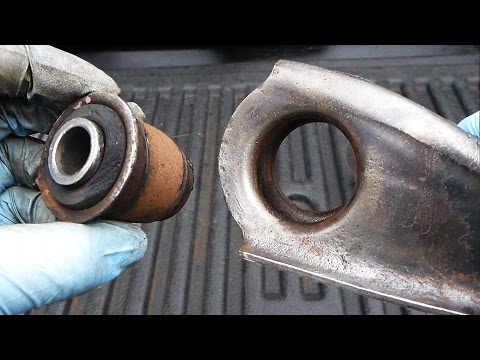
When explaining this to a car owner, focus on "Suspension Geometry." Tell them that the bushing is the "joint" of their car’s leg. If the joint is installed crooked, the car will "limp," causing the tires to scrub and wear out in weeks rather than years. Professional installation with GSW parts ensures the "joint" works exactly as the factory intended.
How long do control arm bushings last?
The lifespan of a control arm bushing typically ranges from 40,000 to 100,000 miles, heavily influenced by environmental exposure, driving habits, and the quality of the rubber compound.
While mileage is a benchmark, time and environment are the real enemies. Most rubber bushings begin to exhibit significant dry-rotting or "cracking" after 5 to 7 years, leading to a degradation in NVH suppression and alignment stability.

Dive Deeper Section:
Predicting the Fatigue Life of a bushing requires a deep dive into material science, specifically focusing on how natural rubber reacts to dynamic loads and ozone exposure. In the B2B manufacturing world, we don’t just guess; we test. GSW bushings undergo rigorous cycle testing where they are subjected to hundreds of thousands of oscillations under load to simulate a decade of city driving. The primary failure mode we observe is "hysteresis"—the heat generated within the rubber as it deforms and returns to shape. If the rubber compound is inferior, this heat breaks down the molecular chains, causing the rubber to soften and eventually tear.
From a mechanic’s view, the "death" of a bushing is often accelerated by "pre-loading." This happens when a technician tightens the control arm bolts while the car is still on a lift with the wheels hanging. This locks the bushing in a twisted position once the car is lowered. To maximize life, the suspension must be at "Ride Height" before the final torque is applied. We solve this "installer error" risk by using high-grade natural rubber with specific anti-ozonants that resist the environmental cracking common in coastal or high-heat regions.
Safety consequences of ignored bushings are severe. As the rubber thins or tears, the control arm gains "play." Under emergency braking, this play allows the wheel to move backward, momentarily changing the vehicle’s wheelbase and confusing the ABS (Anti-lock Braking System). By the time a driver hears a "clunk," the bushing has likely been failing for months, causing invisible damage to the ball joints and tires.
When speaking to a customer, use the "Rubber Band" analogy. A fresh rubber band is snappy and strong; an old one left in the sun becomes brittle and snaps. GSW bushings are like "industrial-strength" rubber bands designed to stay snappy despite the heat of the engine and the salt on the winter roads.
Control Arm Bushings vs. Rubber Bushings
While all control arm bushings contain rubber, the term "Rubber Bushing" often refers to generic, non-specialized components that lack the specific engineering required for modern automotive suspension systems.
A dedicated GSW Control Arm Bushing is a high-precision assembly designed with a specific Shore Hardness A rating to balance comfort and control. Unlike generic rubber parts, our bushings feature reinforced metal sleeves and specialized bonding to withstand extreme torsional loads.

Dive Deeper Section:
In the world of suspension, "Rubber" is a broad category, but "Control Arm Bushings" are a specialized application of NVH (Noise, Vibration, and Harshness) engineering. The biggest differentiator is the Shore Hardness A scale. A generic rubber part might be too soft (causing "mushy" steering) or too hard (transmitting every pebble on the road into the cabin). At GSW, we calibrate our Shore Hardness to match OEM specifications, typically hovering between 60 and 70 Durometer. This allows the bushing to absorb high-frequency road noise while remaining stiff enough to maintain alignment during high-speed cornering.
The physics of a control arm bushing are fascinating. It must act as a pivot point, a spring, and a dampener all at once. Standard "rubber bushings" found in general industrial applications lack the "interleaf" technology—internal metal shims or specific void geometries—that automotive bushings require. Our CAE Analysis allows us to design "Variable Rate" bushings. These feel soft during small bumps (for comfort) but stiffen up significantly during hard turns (for safety).
From a mechanic’s perspective, the difference is most apparent during installation. Generic bushings often have inconsistent outer diameters, leading to them either sliding in too easily (bad fit) or requiring excessive force that shears the rubber. GSW’s precision-machined sleeves ensure a consistent "interference fit" every time. This reliability is why professional shops prefer specialized automotive bushings over "white-label" generic alternatives.
To explain this to a car owner, compare it to footwear. A "generic rubber" part is like a flip-flop—it’s rubber, but you wouldn’t run a marathon in it. A GSW Control Arm Bushing is like a high-performance running shoe—engineered with specific support zones to protect your body (the car) during high-impact activities.
How much are Control Arms?
The cost of control arms can vary significantly, ranging from $50 to $250 per arm, depending on whether you are replacing the entire assembly or just the bushings.
Replacing just the bushings is a cost-effective strategy for high-value aluminum arms, often saving 60% in parts costs. However, if the control arm itself is bent or the integrated ball joint is worn, a full GSW Control Arm assembly is the safest and most efficient solution.

Dive Deeper Section:
The financial decision between replacing a bushing versus the entire control arm is a classic B2B dilemma. For many modern vehicles, especially those using cast aluminum arms, the ball joint is "built-in" and not serviceable. In these cases, even if your GSW bushing is perfect, a failed ball joint necessitates a full arm replacement. However, for steel stamped arms where the ball joint is bolted on, replacing only the bushings with GSW units is a massive value-add for the end consumer and a higher-margin service for the repair shop.
From a "Mechanic’s View," labor is often the most expensive component. It takes roughly the same amount of time to remove the arm regardless of what you do with it. If a shop has a hydraulic press1 and a skilled tech, pressing in new GSW bushings is a "high-skill" service that justifies a premium labor rate while keeping the parts bill lower for the customer. Conversely, for a DIYer, buying a complete GSW Control Arm assembly2—with the bushings and ball joints already pre-installed—is the path of least resistance. It eliminates the need for a press and ensures that every wear point is refreshed in one go.
We must also consider the "hidden costs" of cheap parts. A low-quality control arm might save $20 upfront but fail within a year, requiring a second labor charge and a second wheel alignment (which usually costs $80-$120). By choosing GSW, customers are investing in Fatigue Life. Our assemblies are tested to meet or exceed OEM standards, ensuring that the "total cost of ownership" is lower over the life of the vehicle.
When selling this to a car owner, frame it as an "Alignment Insurance Policy." Tell them: "You’re already paying for the labor and the alignment. Do you want to do it again next year with cheap parts, or do it once with GSW and forget about it for the next 80,000 miles?"
Conclusion
Investing in high-quality lower control arm bushings is essential for vehicle safety and steering precision. Whether you are performing a precision bushing press-fit or replacing the entire assembly, GSW Autoparts provides the OEM-grade durability your vehicle deserves. Contact us today to upgrade your suspension’s performance.
About the Author
Root is a Content & Operations Specialist at GSWAUTOPARTS with 5 years of industry experience. Leveraging his close proximity to our manufacturing floor, Root specializes in documenting product details and production processes. He focuses on translating technical insights about rubber and chassis parts into clear, helpful information for our customers.


