
How to test control arm bushings?
Struggling with steering wander or clunking noises over bumps? Worn control arm bushings can compromise vehicle safety and alignment. This comprehensive guide details professional diagnostic techniques to help you identify failures before they lead to costly suspension repairs.
To accurately test control arm bushings, perform a visual inspection for rubber dry rot followed by a pry-bar leverage test to detect excessive movement. BOLD: Proper testing ensures the suspension maintains correct geometry under load, preventing premature tire wear and erratic handling.

Understanding the health of your chassis components is not just about maintenance; it is about preserving the precision-engineered dynamics of your vehicle’s suspension system.
What does a control arm bushing do?
Control arm bushings act as the critical pivot points between the vehicle’s frame and the wheel assembly. They allow the suspension to move vertically while maintaining horizontal alignment.
The primary role of a control arm bushing is to provide a flexible joint that absorbs road shocks and vibrations. BOLD: By isolating the chassis from road noise, these components are the frontline defenders of a vehicle’s NVH performance.

Dive Deeper Section:
From a physics and material science perspective, a control arm bushing is a sophisticated vibration dampener. In the world of automotive engineering, we focus heavily on NVH (Noise, Vibration, and Harshness). A bushing isn’t just a piece of rubber; it is a tuned spring. When a vehicle hits a pothole, the kinetic energy must go somewhere. Without a bushing, that energy travels directly into the passenger cabin, leading to a harsh ride and structural fatigue on the frame.
The rubber compound within the bushing is designed to handle multi-axial loads. It must resist compression while allowing for torsion (twisting) as the control arm moves up and down. This balance is achieved through precise material engineering. At GSW, we analyze the Shore Hardness A of the rubber to ensure it provides enough "give" to satisfy comfort requirements while remaining stiff enough to maintain steering precision. If the rubber is too soft, the steering feels "mushy" because the control arm is shifting laterally under load. If it is too hard, the ride becomes punishingly stiff.
Furthermore, these components are essential for maintaining the vehicle’s "dynamic alignment." While a car might look aligned while sitting still on a rack, worn bushings allow the wheels to shift backward or forward during braking and acceleration (caster and toe changes). This is why a high-quality bushing is vital for safety; it ensures that the contact patch of the tire remains optimal regardless of the road conditions.
For car owners, explaining this is simple: the bushing is like the cartilage in a human knee. Once it wears out, you have "bone on bone" contact, which leads to pain (noise) and poor mobility (handling).
Why It Matters for Automotive Suspension Parts Manufacturing?
Manufacturing control arm bushings requires a deep understanding of chemical bonding and mechanical stress. High-quality parts are the result of rigorous testing and superior material selection.
In B2B manufacturing, the quality of a bushing determines the long-term reputation of a brand. BOLD: Utilizing advanced Vulcanization processes and high-grade rubber ensures that parts exceed standard fatigue life expectations in the field.

Dive Deeper Section:
In the competitive landscape of automotive parts manufacturing, the difference between a "white box" part and a premium GSW component lies in the Fatigue Life. Most market-standard bushings are designed to pass basic tests—perhaps 500,000 to 700,000 cycles. However, at GSW, our engineering philosophy is built on an "OEM+" standard. We subject our bushings to CAE Analysis (Computer-Aided Engineering) before they ever hit the production floor to simulate years of real-world abuse.
The most critical stage of production is Vulcanization. This is the chemical process where the rubber is bonded to the inner and outer metal sleeves. If the temperature or pressure is off by even a small margin, the bond will be weak. In the field, this results in "delamination," where the rubber pulls away from the metal. To prevent this, our laboratory tests focus on tensile strength and bond integrity, ensuring that the rubber fails before the bond does.
We also prioritize a higher-than-average fatigue cycle requirement. By pushing our testing to over 1,000,000 cycles, we ensure that our bushings can handle the extreme environments of fleet vehicles and heavy-duty applications. This is a significant selling point for B2B clients: the cost of a part is negligible compared to the cost of labor and vehicle downtime. A part that lasts twice as long provides exponentially more value to the end-user.
When explaining this to a car owner, a mechanic should focus on the "Total Cost of Ownership." Choosing a cheaper, lower-spec bushing might save $20 today, but if it fails in 12 months, the owner will pay for the labor and a new alignment all over again. A GSW bushing is an investment in "doing the job once."
3 Signs of a Failing Control Arm Bushing
Identifying a failing bushing early can save other suspension components from premature wear. Technicians look for specific auditory and physical cues during the diagnostic phase.
The most common signs include clunking noises during weight transfer, uneven tire wear, and steering wheel vibration. BOLD: Detecting these symptoms early prevents the control arm from damaging the subframe or causing an accident.

Dive Deeper Section:
The "Mechanic’s View" of a failing bushing is often more about feel than sight. The first sign is usually auditory. When a driver brakes or accelerates, the vehicle undergoes a weight transfer. If the rubber in the control arm bushing has perished, the metal inner sleeve will strike the outer housing. This creates a distinct "clunk" or "pop" sound.
The second sign is Steering Wander. Because the bushing no longer holds the control arm in a fixed position, the wheel’s alignment constantly shifts. On a highway, the driver may feel like they are constantly correcting the steering just to stay in a straight line. This isn’t just annoying; it’s a safety hazard, especially in emergency swerve maneuvers where the suspension’s unpredictability can lead to a loss of control.
Thirdly, we look at Uneven Tire Wear. Specifically, "feathering" or "cupping" on the inner edge of the tire. This happens because the worn bushing allows the tire’s toe setting to change dynamically as the car moves. You are essentially scrubbing the rubber off the tire as you drive.
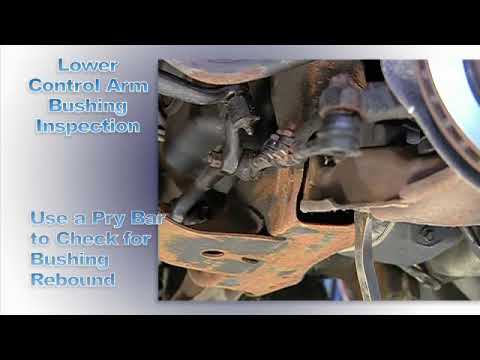
I recently watched a technical demonstration by Hunter Engineering, the global leader in wheel alignment technology. The video masterfully illustrates the ‘Spring Back’ diagnostic method—a professional technique that mirrors our testing philosophy at GSW.
It shows that a bushing’s health isn’t just about the absence of cracks, but about its ability to maintain elastic memory under extreme leverage. Watching how the rubber responds to a pry bar provides a real-world perspective on why we prioritize high-grade vulcanization in our manufacturing process.
To a car owner, this is about "Tire Insurance." Replacing a $50 bushing is much cheaper than replacing a $200 tire that was destroyed by poor alignment.
How much for control arm bushing replacement?
The cost of replacement varies significantly based on whether you replace just the bushing or the entire control arm assembly. Labor is typically the largest factor in the total bill.
Replacement costs usually range from $150 to $450 per side, depending on vehicle make and labor rates. BOLD: Replacing the entire control arm is often more cost-effective than pressing out old bushings due to reduced labor time.

Dive Deeper Section:
The economics of bushing replacement are a common point of discussion in the B2B world. From a mechanic’s perspective, "time is money." Pressing a bushing out of an old control arm requires a hydraulic press and specialized adapters. It is a labor-intensive process that carries the risk of damaging the arm itself. If a technician spends an hour pressing one bushing, the labor cost often exceeds the price of a complete GSW control arm assembly with the bushings already pre-installed.
From a manufacturing standpoint, providing the full assembly is the preferred solution for quality control. When a customer buys a complete GSW control arm, they are getting a factory-sealed unit where the Shore Hardness A of the rubber and the integrity of the arm have been tested as a single system. This eliminates the "human error" factor of a technician potentially installing a bushing at the wrong clocking angle (which can cause the new bushing to tear immediately).
Furthermore, there is the "Safety Consequence" angle. If a bushing has failed, the ball joint on that same control arm is likely nearing the end of its life as well. Replacing the whole unit ensures that the entire corner of the suspension is refreshed, providing the car owner with a "like-new" driving experience and a much longer service interval.
For a car owner, the best way to explain this is through a "Labor vs. Parts1" breakdown. It’s often cheaper to buy a $120 part and pay for 1 hour of labor than to buy a $30 part and pay for 3 hours of labor. Plus, they get a brand-new ball joint2 in the deal.
Conclusion
Testing control arm bushings is a vital skill for maintaining vehicle safety and performance. By combining visual checks with leverage tests and choosing high-spec GSW parts, you ensure a smoother, safer ride. Contact GSW Autoparts today for premium suspension solutions that exceed industry standards.
GSW is trusted by customers for its excellent service and high-quality products. We welcome your immediate inquiries.
About the Author
Root is a Content & Operations Specialist at GSWAUTOPARTS with 5 years of industry experience. Leveraging his close proximity to our manufacturing floor, Root specializes in documenting product details and production processes. He focuses on translating technical insights about rubber and chassis parts into clear, helpful information for customers.


