
What are u bolts used for?
In the heavy-duty automotive aftermarket, few components are as deceptively simple yet structurally critical as the U-bolt. It serves as the primary clamp that holds the vehicle’s suspension geometry together under immense dynamic loads.
U-bolts are U-shaped fasteners with machine threads on both legs, primarily used in the automotive industry to secure leaf springs to axles. They provide the necessary permanent clamping force to maintain suspension alignment and prevent center bolt failure.

While they appear to be basic hardware, the engineering behind a U-bolt involves complex physics regarding tension, fatigue life, and material science. Understanding their specific applications, measurement protocols, and installation nuances is essential for distributors and fleet mechanics alike to ensure safety and longevity.
How are u bolts measured?
Correct measurement is the first line of defense against costly returns and installation delays in the parts distribution business.
To order the correct U-bolt, you must measure three specific dimensions: Rod Diameter (A), Inside Width (B), and Leg Length (C). additionally, the Bend Type (Round, Semi-Round, or Square) must match the axle profile perfectly to ensure uniform load distribution.

Dive Deeper Section:
I recently watched a video by Stengel Bros Inc. that perfectly illustrates the precision required in this process. The presenter breaks down the distinct difference between measuring the "center-to-center" width versus the "inside width." This distinction is critical because ordering based on center-to-center measurements often leads to receiving a bolt that is too wide, resulting in poor thread engagement and compromised structural integrity.
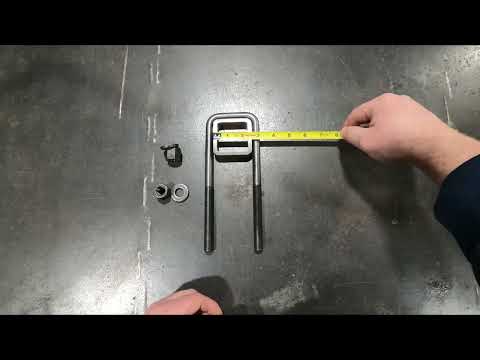
From an engineering and manufacturing perspective, the Inside Width (ID) is the most critical tolerance. At GSW, we emphasize that the U-bolt must fit the axle tube or saddle as snugly as possible without forcing it. If the ID is too large, the legs will splay outward when torqued. This introduces a bending moment into the fastener leg, a stress it is not designed to handle. U-bolts are designed for pure tension (pulling force), not bending. When a bolt is subjected to bending forces due to incorrect measurement, it creates stress risers that significantly reduce its Fatigue Life.
Furthermore, accurate measurement extends to the thread pitch. In heavy-duty applications, fine threads (UNF) are often preferred over coarse threads (UNC) because they have a larger minor diameter (more cross-sectional area), providing higher tensile strength and better resistance to vibration-induced loosening. When sourcing these parts, simply asking for a "standard U-bolt" is insufficient. We recommend using digital calipers to measure the rod diameter to the nearest millimeter or fraction of an inch to match the OEM specifications exactly.
Sales Enablement Tip: When a customer asks for a replacement U-bolt, always ask them to bring the old one or measure the mating surface (the axle). Remind them that the "Leg Length" should be measured from the bottom of the bend to the tip of the leg, but it is always better to have extra length that can be cut off than to be short by half an inch.
How Are U-Bolts Used in Automobiles?
The automotive chassis relies on the U-bolt as the fundamental anchor for the leaf spring suspension system.
U-bolts are used to clamp the leaf spring pack1 firmly against the axle seat. This clamping action serves two purposes: it prevents the leaf springs from sliding longitudinally along the axle, and it ensures the vehicle’s ride height2 and handling characteristics remain stable under load.

Dive Deeper Section:
To truly understand the role of a U-bolt in an automobile, we must look at the Material Science behind it. At GSW, we prioritize the use of High-Tensile Alloy Steel (such as SAE 4140) treated with a Quench and Temper (Q&T) process. Why is this specific grade and treatment necessary?
In a vehicle suspension, the U-bolt acts as a high-tension spring. Its job is to provide a massive Clamping Force that compresses the leaf spring pack. This force must be maintained even as the vehicle hits potholes, vibrates, and flexes. Standard carbon steel often lacks the yield strength to maintain this tension over time, leading to what engineers call "relaxation." If the U-bolt relaxes even slightly, the clamping force drops.
The consequences of lost clamping force are severe. First, it leads to NVH (Noise, Vibration, and Harshness) issues, often manifesting as a clunking sound from the rear of the vehicle. More critically, the loss of friction between the leaf spring and the axle seat transfers all the shearing forces (acceleration and braking forces) to the Center Bolt of the leaf spring. The center bolt is a small locator pin, not a structural fastener. It will shear off almost immediately if the U-bolts are loose, causing the axle to shift, potentially leading to catastrophic suspension failure.
By utilizing SAE 4140 alloy steel, we ensure the U-bolts possess the high Yield Strength required to withstand the initial torque without snapping, and the ductility to handle the cyclic loading of daily driving. The Quench and Temper process refines the grain structure of the steel, ensuring it is tough rather than brittle. This means that in the event of an extreme overload, the bolt is more likely to deform slightly rather than fracturing suddenly, adding a layer of safety for the vehicle operator.
When to Use a U-Bolt?
U-bolts are not reusable components; they must be replaced during specific maintenance events to ensure safety.
New U-bolts should be installed whenever the leaf springs are replaced, a lift kit is installed, or the existing nuts have been loosened for any repair. Reusing old hardware is a leading cause of suspension instability.

Dive Deeper Section:
The industry rule is strict: Never reuse a U-bolt. To understand why, we have to look at the physics of Plastic Deformation.
U-bolts are torque-to-yield fasteners. When a mechanic tightens the nuts to the specified torque (often exceeding 300 ft-lbs on heavy trucks), the steel of the U-bolt stretches. This stretch is intentional; it acts like a rubber band pulling the joint together. However, this stretching often pushes the material past its elastic limit and into the plastic region. Once a metal has been plastically deformed, it does not return to its original shape when the load is removed.
If you attempt to reuse a U-bolt, the threads have already been stretched and distorted. The pitch of the threads may no longer match the nut perfectly. When you apply torque to a used bolt, a significant portion of that force is wasted fighting the friction of the damaged threads (known as "thread galling") rather than generating vertical clamping force. You might hit the "click" on your torque wrench, but the actual clamping pressure on the spring pack could be 40-50% less than required.
Sales Enablement Strategy:
Mechanics often try to save money by reusing old bolts. As a parts supplier, you can educate them on the liability. Explain it this way: "The U-bolt is the only thing holding the axle to the vehicle. For the cost of a few dollars, reusing a stretched bolt risks a suspension failure that could cost thousands." Furthermore, old bolts suffer from corrosion fatigue. Micro-cracks caused by rust can propagate rapidly under tension. Promoting a "U-bolt kit" add-on with every leaf spring sale is not just good up-selling; it is a mandatory safety practice.
How to Install U-Bolts?
Proper installation technique is just as important as the material quality of the bolt itself.
U-bolts must be tightened using a cross-pattern sequence to ensure even pressure distribution. Threads should be clean and lubricated, and the final torque must be applied with a calibrated torque wrench, not just an impact gun.

Dive Deeper Section:
The installation process defines the Fatigue Life of the assembly. The most critical step that is often skipped is Retorquing.
When new U-bolts are installed on a fresh leaf spring3 pack, the assembly is not static. As the vehicle is driven for the first 50 to 100 miles, the layers of steel in the leaf spring "settle" and compact together. Additionally, the U-bolt itself may experience a slight amount of initial stretch. This settling causes the effective length of the clamped joint to decrease, which immediately reduces the tension in the bolt.
From a mechanic’s perspective, this means a U-bolt that was perfectly torqued in the shop can be dangerously loose a week later. We recommend a mandatory service check after 50-100 miles to retorque the nuts to the original specification.
Another technical nuance is the use of Deep Nuts and Hardened Washers. Standard nuts may strip under the high torque requirements of suspension work. GSW recommends using Grade 8 (or Class 10.9) deep nuts which provide more thread engagement. The washers must be hardened structural washers; soft washers will crush and dish out under the nut, leading to a false torque reading and eventual loosening.
Finally, avoid using anti-seize compounds unless the manufacturer specifically calls for it. Lubricants drastically reduce friction, which can lead to Over-Torquing. If the spec calls for "dry torque" and you add lube, you might inadvertently stretch the bolt beyond its yield point, snapping it before the torque wrench ever clicks. Always follow the specific torque chart provided with our SAE 4140 U-bolts.
Conclusion
U-bolts are precision-engineered safety components, not generic hardware. By choosing high-tensile alloy steel (SAE 4140) and adhering to strict measurement and installation protocols, you ensure vehicle stability and safety. Contact GSW Autoparts today to explore our catalog of premium, heat-treated U-bolts designed for the toughest B2B applications.
About the Author
Root is a Content & Operations Specialist at GSWAUTOPARTS with 5 years of industry experience. Leveraging his close proximity to our manufacturing floor, Root specializes in documenting product details and production processes. He focuses on translating technical insights about rubber and chassis parts into clear, helpful information for our customers.
Understanding leaf spring packs is crucial for vehicle stability and performance, making this resource invaluable for automotive enthusiasts. ↩
Exploring this topic will provide insights into how ride height influences vehicle dynamics, essential for optimizing performance. ↩
Learn about leaf springs to enhance your knowledge of vehicle dynamics and improve maintenance practices. ↩


