
What is a lower control arm bushing?
Struggling with steering instability or annoying clunking noises? Understanding the role of lower control arm bushings can prevent costly suspension failures. This guide clarifies their function, signs of wear, and why material quality determines your vehicle’s safety.
Lower control arm bushings are critical suspension components that act as vibration isolators between the control arm and the vehicle chassis. By absorbing road shocks and maintaining alignment, they ensure precise handling and optimal driving comfort while protecting metal components from premature metal-on-metal wear.

While they may seem like simple rubber-and-metal cylinders, these components are the silent heroes of your vehicle’s chassis, balancing the brutal forces of the road with the need for a refined cabin experience.
What are lower control arm bushings?
Lower control arm bushings are flexible "joints" made of rubber or polyurethane encased in metal sleeves, connecting the control arm to the car’s frame.
They serve as a pivot point for the suspension, allowing the wheels to move up and down smoothly while dampening road noise and vibrations. Without them, every bump would transmit directly to the cabin, compromising both comfort and vehicle structural integrity.

Dive Deeper Section:
From an engineering perspective, the lower control arm bushing is the primary defense mechanism against NVH (Noise, Vibration, and Harshness). At GSW, we treat the bushing not just as a spacer, but as a calibrated dampening instrument. The magic lies in our proprietary rubber formulation. Unlike standard aftermarket parts that use high-filler, low-grade synthetic rubber, we utilize a high-percentage Natural Rubber (NR) compound. This specific recipe ensures that the Shore Hardness A rating remains consistent between -40°C and +80°C, preventing the rubber from becoming brittle in winter or too soft in summer.
The interaction between the rubber and the inner metal sleeve is critical. We use a high-strength bonding process during vulcanization to ensure the rubber never delaminates from the metal, even under extreme torsional stress. This is vital for maintaining the static and dynamic stiffness required for modern vehicle steering geometry. If the rubber is too hard, you feel every pebble on the road; if it is too soft, the car feels "floaty" and unresponsive. Our CAE Analysis (Computer-Aided Engineering) allows us to simulate these forces before a single mold is poured, ensuring the damping curve matches the OE (Original Equipment) specifications perfectly.
Sales Enablement: When explaining this to a car owner, describe the bushing as the "cartilage" in a human knee. Just as worn cartilage leads to painful bone-on-bone contact, a worn bushing leads to metal-on-metal impact that can damage the entire suspension subframe.
How long should control arm bushings last?
Most control arm bushings are designed to last between 50,000 to 80,000 miles, depending on road conditions and driving habits.
Longevity is heavily influenced by environmental exposure, such as salt, oil leaks, and extreme heat, which degrade the rubber over time. Regular inspections every 12 months are recommended to identify dry rot or tearing before total failure occurs.

Dive Deeper Section:
The lifespan of a bushing is defined by its Fatigue Life. In the world of rubber chemistry, we focus on "cross-linking density." Over years of operation, the rubber undergoes millions of compression and tension cycles. Each cycle generates internal heat; if the rubber compound cannot dissipate this heat or lacks sufficient anti-ozonants, it begins to "crack" or "dry rot." This is thermo-oxidative degradation. At GSW, we add specific antioxidants to our rubber mix to fight this process, significantly extending the service life compared to "budget" alternatives.
Another factor often overlooked by mechanics is chemical contamination. If an engine has a slight oil leak, the petroleum-based oil can drip onto the control arm bushing. Since standard rubber is susceptible to hydrocarbons, the oil causes the rubber to swell and lose its structural integrity—a process called "solvent swelling." During our manufacturing process, we ensure our vulcanization parameters create a dense molecular structure that offers better resistance to environmental contaminants.
We also conduct rigorous "Salt Spray Testing" on the metal sleeves to ensure that the outer casing doesn’t rust and seize into the control arm, which would make future replacements a nightmare for the technician. By focusing on these micro-details, we ensure that a GSW bushing doesn’t just "fit," but survives the grueling reality of daily driving.
What to do if the control arm breaks while driving?
A broken control arm or a total bushing collapse is a critical safety emergency that requires immediate, controlled deceleration.
If you hear a loud snap or lose steering control, do not slam the brakes. Gradually ease off the accelerator, maintain a firm grip on the steering wheel, and pull over safely. The vehicle is no longer safe to operate and must be towed.

Dive Deeper Section:
The physics of a control arm failure are terrifying. The control arm manages the "Caster" and "Camber" angles of your wheel. If a bushing completely disintegrates or the arm snaps, the wheel is no longer held in its vertical or longitudinal axis. Under braking, the wheel may pull violently toward the rear of the wheel well, causing the car to veer sharply into another lane. This is why we emphasize CAE Analysis during our design phase; we test the "Ultimate Tensile Strength" of the assembly to ensure that even under a massive impact (like hitting a deep pothole at 60 mph), the component deforms rather than shatters.
From a safety consequence standpoint, a failed bushing often leads to "uncontrolled toe change." This means that as you accelerate or brake, the front wheels point in different directions. This puts immense stress on the Tie Rod ends and the Steering Rack. Replacing a $20 bushing today is a small price compared to replacing a $1,000 steering rack tomorrow because the vibration from a dead bushing vibrated the internal seals to death.
Safety is paramount. We advise all our B2B partners to inform their clients that "ghosting1" or "wandering" steering at high speeds is the first warning sign of a compromised control arm assembly2. Ignoring it is essentially gambling with the vehicle’s directional stability.
Do I need to replace mine?
Determining if you need a replacement involves a combination of listening for symptoms and performing a physical inspection.
Key indicators include steering wheel vibration, uneven tire wear, and a "clunking" sound when driving over bumps. If the rubber shows deep cracks or the inner sleeve is off-center, immediate replacement is necessary to restore safety.

Dive Deeper Section:
The most effective way to diagnose a bad bushing is the "Pry Bar Test." With the vehicle on a lift, a technician inserts a pry bar between the control arm and the frame. If there is more than a few millimeters of movement, or if the rubber "squishes" excessively, the fatigue life has been reached. I recently watched a video that demonstrates this perfectly—you can see how a worn bushing allows the entire wheel assembly to shift unnaturally, which explains why your alignment feels "off" even after a professional adjustment.
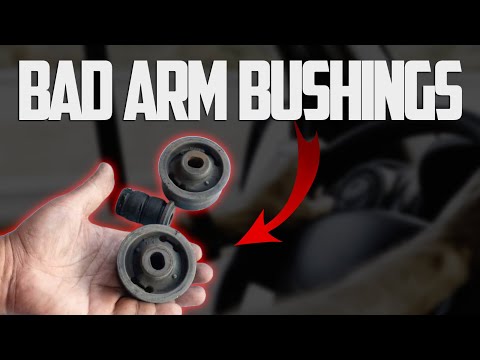
For professional shops, it is important to communicate the "Efficiency Loss" to the customer. A bad bushing doesn’t just feel bad; it costs money. Because the wheel isn’t held straight, the tires "scrub" against the road surface, leading to "feathering" or "cupping" on the tread. You could ruin a brand-new set of tires in less than 5,000 miles if your bushings are shot.
At GSW, we provide full control arm assemblies as well as individual bushings. For older vehicles, we often recommend replacing the entire arm. Why? Because if one bushing is gone, the ball joint and the other bushings are likely near their end-of-life too. It saves the customer labor costs in the long run by doing the job once and doing it right.
Conclusion
Lower control arm bushings are vital for safety, comfort, and tire longevity. Choosing high-quality parts with the right rubber chemistry ensures your vehicle remains stable and quiet. Don’t wait for a failure; inspect your bushings today. Contact GSW Autoparts for premium, engineered suspension solutions.
About the Author
Root is a Content & Operations Specialist at GSWAUTOPARTS with 5 years of industry experience. Leveraging his close proximity to our manufacturing floor, Root specializes in documenting product details and production processes. He focuses on translating technical insights about rubber and chassis parts into clear, helpful information for our customers.


